.png)
Aug 19, 2026

Fertility isn’t something most people think about until they’re ready. And when that time comes, many expect things to happen naturally, smoothly, and without much effort
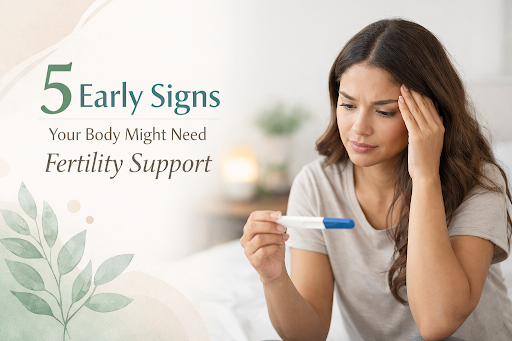
Fertility isn’t something most people think about until they’re ready.
And when that time comes, many expect things to happen naturally, smoothly, and without much effort.
But for some, the journey feels slower than expected. And often, it’s not because something is “wrong” — it’s because the body has been quietly asking for support long before the journey even began.
The truth is, your body is always communicating. The question is whether we’re noticing the signals early enough.
Here are five early signs that your body might need fertility support — not as a cause for alarm, but as an invitation to understand your health more deeply.
You don’t need to have completely irregular periods for something to be worth noticing.
Sometimes it’s more subtle:
These small inconsistencies can reflect how your hormones are functioning.
Ovulation is one of the most important parts of fertility. If it’s not happening regularly, or if timing is unpredictable, it can make conception more difficult.
What matters here is not perfection, but consistency. When your cycle feels unpredictable, it may be your body’s way of asking for support.
Many people assume their period is “normal” simply because it has always been that way.
But your period is a reflection of your internal health, and changes over time can be meaningful.
You might notice:
These changes can sometimes be linked to hormonal balance, uterine health, or underlying conditions that affect fertility.
It’s not about comparing your cycle to someone else’s. It’s about noticing what’s different for you.
Fatigue is one of the most overlooked signals when it comes to fertility.
It’s easy to blame it on work, routine, or daily responsibilities. But when tiredness becomes persistent, it may point to something deeper.
Your reproductive system is closely connected to your overall health. If your body is low on energy, it may prioritize essential functions over reproductive ones.
This can be influenced by:
When your energy feels consistently low, your body may be signaling that it needs support before it can function optimally.
Your body often reflects internal changes externally.
You might notice:
These changes can sometimes be linked to shifts in hormones, particularly those involved in fertility such as estrogen, progesterone, and androgens.
While these symptoms are common, they shouldn’t always be dismissed.
They can be early indicators that your body is out of balance and may benefit from support.
This is often the moment when people start paying closer attention.
You’ve been trying. You’ve been mindful. And yet, nothing is happening.
It’s important to understand that conception doesn’t always happen immediately. For many couples, it takes time.
But if months pass without progress, it may be worth exploring whether your body needs additional support.
General guidance suggests:
But timelines are not the only measure.
Sometimes, the feeling that “something is off” is enough reason to start asking questions.
The challenge with early fertility signals is that they often don’t feel urgent.
They don’t stop you from going to work. They don’t disrupt your daily routine in a major way.
So they get normalized.
You tell yourself:
And sometimes, it does.
But sometimes, those small signals are your body’s way of asking for attention before things become more difficult later on.
Hearing the word “support” can feel intimidating. It can sound like something serious or medical.
But fertility support can start in very simple, accessible ways.
For many people, it begins with:
For others, it may involve:
Support doesn’t mean something is wrong. It means you’re choosing to be proactive.
Instead of asking, “Is something wrong with me?”
It may be more helpful to ask:
“What does my body need right now?”
This shift in perspective changes everything.
It removes pressure and replaces it with curiosity.
It replaces fear with understanding.
And it allows you to approach your fertility journey with more clarity and confidence.
One of the biggest misconceptions about fertility is that you only need to pay attention when something goes wrong.
But the reality is, the earlier you understand your body, the more empowered you are in your choices.
You don’t need to wait for a diagnosis.
You don’t need to wait for frustration.
You can start by simply paying attention.
Fertility is not just about outcomes. It’s about the journey that leads there.
At Fertile.right, the goal is to make that journey more supported, more informed, and easier to navigate.
Whether you’re just beginning or already on your path, understanding these early signs can help you take your next step with more confidence.



Future of Fertility, done Right
© 2026 Fertile.right. All Rights Reserved.